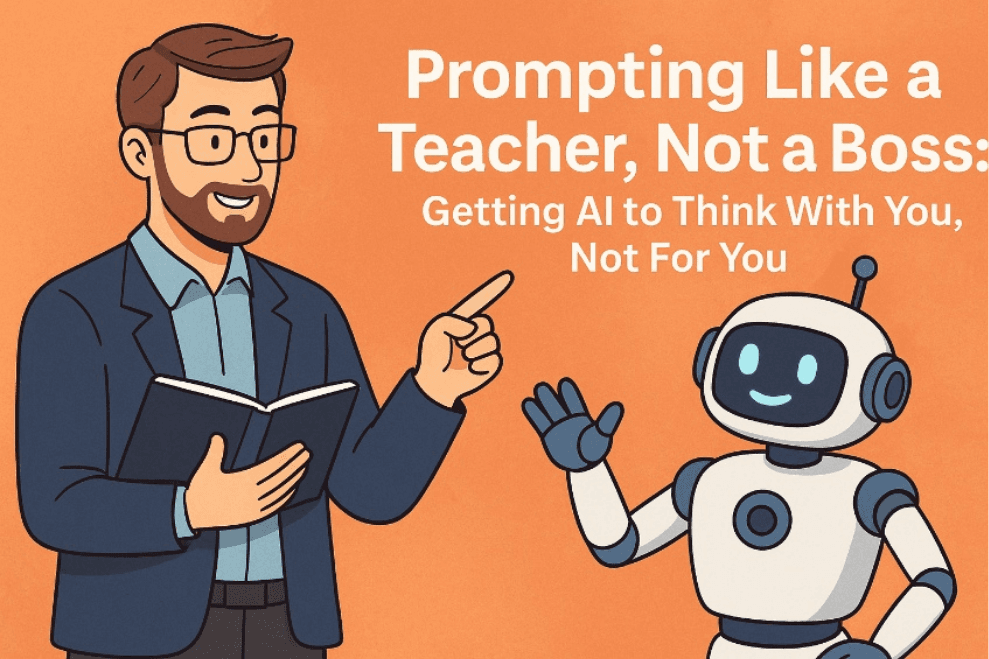
The New Age of Human–AI Collaboration
For decades, leadership was defined by command-and-control—clear direction, fast execution, and measurable outcomes. But as artificial intelligence becomes a co-worker instead of a tool, this "boss mindset" limits both creativity and performance.
In this new era, effective prompting is less about commanding and more about coaching. The most powerful AI users aren't bosses telling machines what to do—they're teachers guiding AI to think with them.
When you learn to prompt like a teacher, your AI becomes a thought partner that deepens insight, challenges assumptions, and expands innovation. The difference between mediocre AI results and transformative ones isn't in the technology—it's in how you talk to it.
That's where Jet Prompt Optimizer (JPO) comes in: an intelligent assistant that helps you design prompts with the same clarity, structure, and intention that great teachers use to unlock human potential.
From "Do This" to "Let's Think Through This"
The human brain is wired to respond to questions, not orders. Neuroscience shows that when we're asked thoughtful questions, our prefrontal cortex activates—enhancing focus, creativity, and problem-solving. AI models, surprisingly, respond the same way.
When you issue a command ("Write me a report on X"), AI delivers predictable, surface-level output. But when you ask a guiding question ("Let's analyze X from multiple perspectives—what insights might emerge if we connect these variables?"), The model activates deeper reasoning chains.
The more your prompt mirrors how educators stimulate thought, the more your AI mirrors human critical thinking. It stops executing and starts collaborating.
That's the core philosophy behind Jet Prompt Optimizer: turning prompts into structured dialogues that spark exploration instead of automation.
The Psychology of Prompting: Teaching the Machine How to Learn
In classrooms, great teachers don't just transfer knowledge, they engineer curiosity. They guide students to think in terms of frameworks, explore connections, and articulate their reasoning.
When applied to AI prompting, this same psychology transforms outcomes. Here's how:
1. Context Creates Cognition
Cognitive science reveals that the brain connects new information to existing schemas. AI, too, thrives on context. Prompts that define why a task matters generate far more coherent, relevant, and insightful responses than isolated commands.
- **Boss-style prompt**: "Summarize this report."
- **Teacher-style prompt**: "Imagine you're briefing an executive team that needs a 3-minute overview of this report to make a funding decision—what key points must be included?"
2. Scaffolding Builds Smarter Results
Educators use scaffolding—breaking complex challenges into manageable, logical steps. Similarly, JPO helps users craft multi-stage prompts that guide AI thinking in a sequential manner.
Instead of dumping all instructions at once, effective prompts mirror a learning progression:
- **Step 1**: Define the goal.
- **Step 2**: Generate diverse ideas.
- **Step 3**: Evaluate options.
- **Step 4**: Present a refined synthesis.
3. Feedback Loops Reinforce Intelligence
In neuroscience, the brain strengthens synaptic pathways through feedback and reflection. AI systems respond to feedback loops the same way—refining responses with each iteration.
Teaching-style prompting includes correction and reflection:
- "Let's revise the previous response, focusing more on emotional storytelling."
- "How could this be improved for a skeptical audience?"
The Empathy Edge in AI Communication
Modern leadership thrives on empathy—understanding perspectives, emotions, and context. The same principle drives high-performing AI collaboration.
When prompts include emotional tone and relational context ("Imagine you're a mentor guiding a young professional through this challenge"), AI generates responses infused with empathy, narrative flow, and relevance.
Behavioral economists call this the empathy effect—when emotion and perspective-taking activate mirror neurons, deepening engagement. JPO leverages this principle through its Prompt Intelligence Engine, which helps users inject warmth, tone, and human intention into every interaction.
The result: AI outputs that feel as intelligent as they are analytical.
Cognitive Co-Teaching: The Future of Work
Imagine AI not as an intern who takes notes, but as a co-teacher—one that reflects, expands, and sometimes challenges your ideas.
This "cognitive co-teaching" model transforms productivity:
- Leaders become facilitators of thinking, not dictators of tasks.
- Teams learn to dialogue with data, not just consume it.
- Organizations shift from automation to augmentation, blending human intuition with algorithmic depth.
How the Brain Learns—and Why AI Does, Too
Neuroplasticity teaches us that repetition and reflection create stronger neural pathways. AI language models "learn" similarly through token-weighted pattern recognition. When you prompt iteratively, you're essentially training micro-patterns of thought.
This means every prompt interaction is a neurocognitive exchange—your brain's pattern of thinking shapes the machine's pattern of response.
JPO's optimization framework uses behavioral and linguistic analytics to:
- Identify missing context or cognitive steps.
- Suggest "teaching-style" structures that increase logical depth.
- Enhance precision and creativity by guiding iterative refinement.
From Command Lines to Conversation Design
The old command-line mindset—"enter input, get output," belongs to the early digital age. Today's AI environment requires conversation design: the art of shaping dialogue that leads to insight.
Just as a teacher crafts open-ended questions to draw out reasoning, effective AI users must learn to create prompts that evoke exploration.
JPO simplifies this process through its built-in Prompt Composer, which structures your input into three essential layers:
- **Intention** – What's the purpose of this prompt?
- **Perspective** – Who is the AI "becoming" to solve it effectively?
- **Process** – What sequence of reasoning will generate the best result?
The ROI of Thinking With AI
When employees interact with AI as thought partners, productivity and creativity skyrocket. Research by MIT's Sloan School found that teams using structured, collaborative prompting improved problem-solving efficiency by up to 43%, while reporting greater satisfaction and reduced cognitive fatigue.
This isn't just about saving time—it's about saving mental energy. When AI participates in the decision-making process, leaders can focus on judgment, empathy, and vision—the human qualities machines can't replicate.
Jet Prompt Optimizer was built precisely for this intersection: to make prompting intuitive, interactive, and intelligent—so your organization learns faster, decides smarter, and innovates continuously.
The Shift from Authority to Inquiry
In education, the most effective classrooms are Socratic—not authoritarian. In business, the most successful AI collaborations will follow the same principle.
Leaders who shift from telling AI what to do to asking AI what it sees will unlock exponential value. The future belongs to those who lead with inquiry, not instruction.
Asking great questions—strategically, contextually, and creatively—isn't just good pedagogy. It's the next leadership superpower.
Final Reflection: Be the Teacher AI Learns From
Every prompt you write is a lesson. Every response you refine is feedback. Together, they form a continuous cycle of co-learning between human and machine.
When you prompt like a boss, you get compliance.
When you prompt like a teacher, you get coherence.
And when you prompt with curiosity, you get collaboration.
Jet Prompt Optimizer was created to empower this transformation—to make AI work with you, not merely for you. Because in the age of intelligent technology, your most significant power isn't in commanding—it's in co-creating.
👉 Ready to elevate your prompts and teach AI to think with you?
Start optimizing today: https://app.jetpromptoptimizer.ai/
🔥 Top 5 Viral Hashtags
#AICommunication #PromptEngineering #LeadershipInnovation #HumanAIcollaboration #JetPromptOptimizer